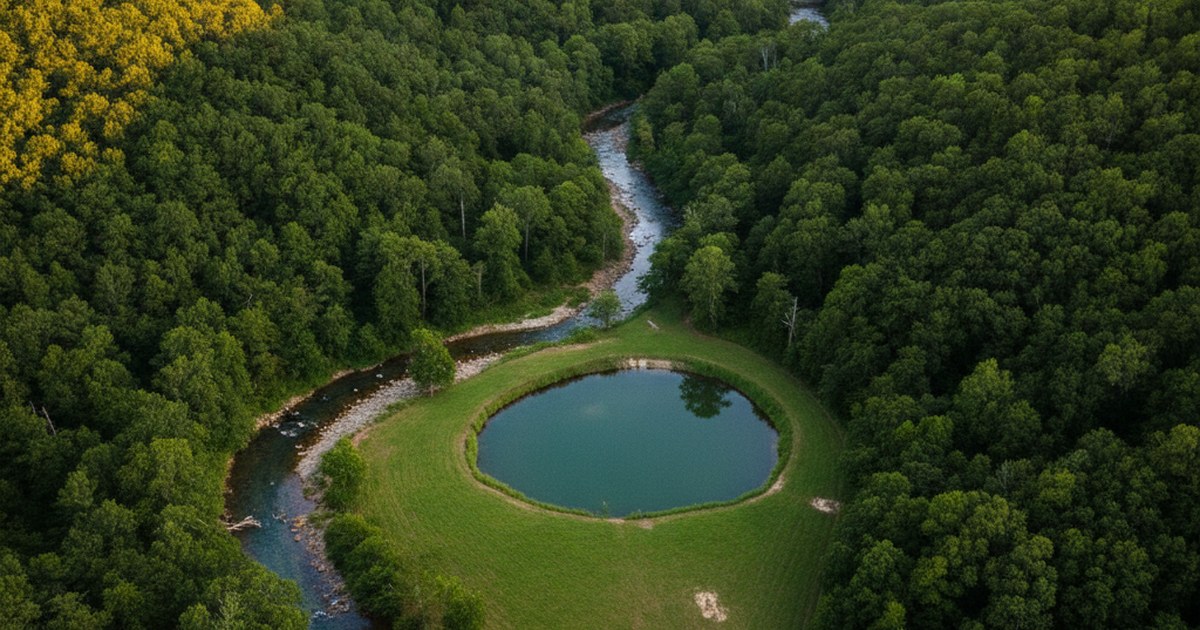
You spotted a creek line on the satellite view of a lot and started picturing a cabin next to it. Water rights control whether you can use a well, spring, or stream on that raw land. In Arkansas the rule is reasonable use: you can use water on or bordering your property, as long as it is fair to the neighbors who share the same source. Check it before you pay.
What are water rights on rural land?
The legal right to use water that is on or under your land. This sounds like it should come with the land itself. It does, but not without limits.
When you buy a parcel, you own the dirt. How much of the water under or on it you can use is a separate legal question. Some states let you pump as much groundwater as you want. Other states ration it by seniority. Arkansas sits in between, and even in Arkansas there are catches.
A parcel may be landlocked by water just as much as by road. You can see the land clearly in a satellite photo. The water question stays invisible until you try to drill.
How do water rights work in Arkansas?
Arkansas uses what the University of Arkansas Division of Agriculture calls a "regulated riparian" system. Its Arkansas Water Primer puts the core rule in one line: "All landowners have the right to make reasonable use of water on or bordering their property."
Reasonable use means balancing the interests of everyone who shares a source. Your use counts, and so does the use of the neighbor downstream or on the same aquifer.
The regulated part is the state. The same primer lists the Arkansas Natural Resources Commission's authority to allocate stream water during shortages, designate critical groundwater areas, and set groundwater rights inside those areas.
So if a stream runs through your property, you cannot pump the whole thing dry. For a single household well, reasonable use is rarely the obstacle. Depth and cost are.
Do you have to register a household well in Arkansas?
Not for withdrawal reporting. Arkansas Code 15-22-302 requires people who withdraw groundwater to report it, but it exempts individual household wells used exclusively for domestic use, and wells with a maximum potential flow rate under 50,000 gallons a day.
For scale, 50,000 gallons a day is irrigation or industrial territory. A cabin well does not come close.
That exemption covers reporting only. It does not mean anyone can drill anywhere with anything, which is the next question.
Who is allowed to drill a well on your land?
A licensed water well contractor. Under Arkansas Code 17-50-104, it is unlawful to enter into a contract for well construction or pump installation, or to hold yourself out as a water well contractor, without posting a bond and holding a license.
For a buyer, that is useful. It means the person you hire answers to a state license, and it gives you one question to ask before any money changes hands: can I see your Arkansas water well contractor license?
A licensed local driller is also your best source on depth. They have drilled the neighbors. Ask what the wells around that parcel came in at before you budget anything.
What should you look for before you buy?
Before you commit to a parcel, ask three things:
-
Is there water on this lot today? Ask the seller, in writing, whether the parcel has a well, a water service connection, a spring, or none of these. If there is a well, ask how deep it was and how reliable it has been.
-
What did nearby wells cost? Call a licensed Arkansas water well contractor who works the area and ask what depth wells near that parcel reached. Depth is the number that decides the bill.
-
Are there restrictions on your parcel? Ask whether the area falls inside a designated critical groundwater area, and read the recorded restrictions for the subdivision. The county GIS map or a title search will show what is recorded.
If the seller says "there is good water on this land," ask to see the well record or a photo. If the seller is vague, assume there is no well and budget for the cost of drilling one.
How deep is a well in Izard County?
Nobody can tell you until a well is drilled, and I will not pretend otherwise. I own land in Izard County, Arkansas, and water is one of the first questions buyers ask. I have not drilled a well on any of my lots, so I will not quote you a depth for them.
What I can point to is published 2026 Arkansas cost data: an average residential well of about 165 feet, and roughly $4,000 to $12,000 for a finished system with pump and tank. I broke that down in what it costs to put utilities on raw land.
Four of my current parcels are in the Spring Addition in Horseshoe Bend. The parcels are small (0.26 to 0.31 acres each), which means they are good for a cabin or camp, not a big homestead. If I were buying one of them myself, I would call a licensed local driller first and ask what the neighboring wells reached.
These are real questions. Not theory.
Is groundwater or surface water better for a rural lot?
For most buyers, groundwater, because it is simpler. The two kinds of water are treated differently in practice.
| Factor | Groundwater | Surface water |
|---|---|---|
| Right to use | Reasonable use | Reasonable use, shared with neighbors along the stream |
| State involvement | Household wells exempt from withdrawal reporting | State can allocate stream water during shortages |
| Who builds it | Licensed water well contractor | Pump installer, filtration |
| Cost of access | Drilling by the foot, pump, pressure tank | Pump, filtration, possible treatment |
| Main risk | Depth to water is unknown until drilled | Flow drops in a drought |
Most rural land owners use groundwater. You drill a well, pump it into a pressure tank, and run pipes to your house or cabin. Surface water needs more treatment and is riskier in a drought.
If your parcel has a spring or stream, you have an option. But plan around a well unless you have already tested the surface source.
What is the full water checklist before you commit?
Five steps, in order, before you buy any rural land:
- Ask the seller: "Is there a well, a water service connection, or neither?" If there is a well, ask for its depth and any record of it. Get the answer in writing.
- Call a licensed Arkansas water well contractor who works the area and ask what depth nearby wells reached.
- Check the county GIS map and the recorded restrictions, and ask whether the area is a designated critical groundwater area.
- If the parcel has a spring or pond, remember that neighbors on the same source share the right to reasonable use.
- Budget for a new well if the existing one is not usable or does not exist. Published 2026 Arkansas data puts a finished system at roughly $4,000 to $12,000, and the quote from a local driller beats any average.
FAQ
What are water rights on rural land?
Water rights are the legal right to use water that is on or under your land. On raw land, this means the right to drill a well, pump from a spring, or draw from a stream or pond. The land itself may be yours, but how much water you can use may be limited by the rights of neighbors and by state law.
Do I own water rights if I own the land?
Not in an unlimited way. States use different systems: rule of capture, reasonable use, or prior appropriation. Arkansas uses a regulated riparian system built on reasonable use, which means every landowner may make reasonable use of water on or bordering their property, balanced against the neighbors who share the same source. The state can allocate stream water during shortages.
How do I know if my rural land has water access?
Ask the seller in writing whether the parcel has a well, a water service connection, a spring, or none of these. Check the county records and GIS map for existing wells, springs, or ponds. Then ask a licensed Arkansas water well contractor what depth nearby wells came in at, because depth is what decides the drilling bill.
Can I drill a well on my raw land?
In Arkansas, a household well is normally allowed under reasonable use, and individual household wells used only for domestic use are exempt from the state's groundwater withdrawal reporting. The work itself has to be done by a licensed water well contractor, since Arkansas law makes it unlawful to contract for well construction without a license. Confirm any local rules for your parcel before you buy.
What is the difference between groundwater and surface water rights?
Groundwater is water beneath the surface that you access by well. Surface water is water on the surface like streams, ponds, or springs. In Arkansas both fall under reasonable use, but surface water in a stream is shared with neighbors along it, and the state can allocate stream water during shortages. You cannot pump a whole stream dry even if it flows through your land.
Water is one piece of the larger due diligence process. My full due diligence checklist before buying rural land walks through road access, flood zone, water, taxes, and the deed in order. Road access deserves its own check too, and my guide on how to spot landlocked land before you buy pairs well with this one. The Arkansas buying hub collects the rest.
For water rules specifically, the University of Arkansas Division of Agriculture's Water Primer series explains the state system in plain language, and the Arkansas Department of Environmental Quality covers water quality.
Have a parcel in mind and want to talk through the water situation? Reach out and describe the location. And if you have already drilled in the Ozarks: how deep did your well end up going?
Prefer to see the lots first? Browse the available lots.
This is not financial or legal advice. Buying land involves risk. Do your own research before purchasing any property.
Sources
- University of Arkansas Division of Agriculture: Arkansas Water Primer Series, Water Rights in Arkansas (FSPPC101)
- Arkansas Code 15-22-302: groundwater withdrawal reporting and the household well exemption
- Arkansas Code 17-50-104: water well contractor license requirement
- Arkansas Division of Environmental Quality: water publications
- Arkansas Department of Environmental Quality
- Izard County Assessor GIS Map
- What are Water Rights?
- Groundwater vs. Surface Water