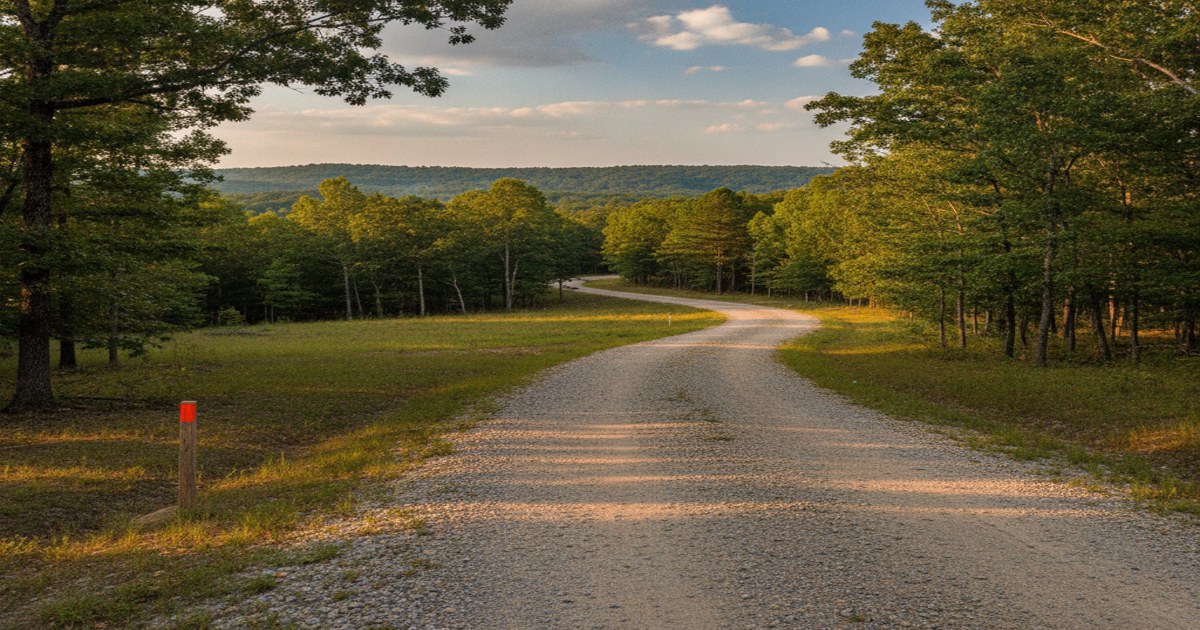
You zoomed in on a cheap lot on the county map and noticed that no road line touches it. Landlocked land is a parcel with no legal road access: it is surrounded by other private lots, so you cannot legally reach it without crossing someone else's property. It is one of the cheapest looking traps in rural land, and you can check for it in a few minutes before you pay a dollar.
What is landlocked land?
A parcel that does not touch any public road. To get to it, you would have to cross land that belongs to someone else, and unless you have a legal right to do that, you have no guaranteed way in.
This matters more than most beginners expect. Access is not about whether you can physically walk onto the lot today. It is about whether you have a recorded, permanent right to reach it, one that survives when the neighbor sells or a gate goes up. Without that right, a landlocked parcel is hard to build on, hard to insure, and hard to sell later.
A lot looks fine in a photo. The road access question is invisible in photos, which is exactly why it gets skipped.
How do you check if land has legal road access?
Open the county GIS map and see whether the parcel touches a public road. You can answer this for free before you talk to a seller, on the same free public map of parcels I point buyers to for every check.
Look at the parcel outline and ask one question: does it touch a public road?
- If a side of the parcel runs along a public road, it has frontage and direct access.
- If the parcel only touches other private lots, it may be landlocked.
- If it reaches a road through a thin strip of land, that is a flag pole lot, and you need to confirm that strip is part of your parcel.
Here is a quick way to read what you see on the map.
| What you see on the GIS map | What it usually means |
|---|---|
| Parcel borders a named public road | Direct legal access, best case |
| Parcel touches only private parcels | Possibly landlocked, verify further |
| Narrow strip connects lot to a road | Flag pole access, confirm the strip is yours |
| Deed mentions an easement | Access may exist by recorded right |
If the map is unclear, the deed is the tiebreaker. A clean deed with a recorded access easement is what turns a questionable lot into a usable one.
What is an easement, and when do you need one?
You need one whenever your lot does not front a public road. An easement is a recorded legal right to cross another person's land to reach yours. For a landlocked parcel, it is the fix. It gives you a permanent, written way in that does not depend on staying friendly with a neighbor.
The key word is recorded. A neighbor saying "sure, use my driveway" is worth nothing the day that neighbor sells. A recorded easement is written into the deed or filed at the county, so it travels with the land and binds the next owner too.
If a seller tells you a landlocked lot has access, ask one thing: is the easement recorded, and can I see it? If the answer is vague, treat the parcel as landlocked until proven otherwise. I wrote a separate walkthrough on how to check for an easement on land.
Why does "recorded" matter so much in Arkansas?
Because Arkansas law ties notice to the county record. Under Arkansas Code 14-15-404, every deed or instrument affecting title is constructive notice to all persons from the time it is filed for record in the office of the county recorder.
In plain terms: a recorded easement is treated as known to every future buyer of the neighbor's land, whether they read it or not. An unrecorded handshake deal has no such protection. The next owner can say they never knew.
That is why the question to a seller is never "is there access?" It is "where is it recorded?" If they can point to the book and page at the county, you have something. If they cannot, you have a story.
Can you force access to landlocked land in Arkansas?
Sometimes, but it costs money and a court process. Arkansas has a private road statute, Arkansas Code 27-66-401, for owners whose land is situated so that a road is necessary to reach a public road or navigable watercourse, and who have been denied access by the neighboring owners.
That owner can petition through the county court. The catch: the petitioner has to deposit money into the court registry to cover the neighbor's damages, including loss of property value and loss of exclusive use of the land the road crosses.
So yes, a legal path exists. But it means a filing, a hearing, and money set aside for the neighbor whose land the road crosses, before you have a road. That is a lot of cost stacked on a lot that looked cheap. Buying a parcel that already fronts a road skips all of it.
Is landlocked land worse than land with road frontage?
For most buyers, yes. The difference between a parcel with road frontage and a landlocked one is the difference between land you can use and land you can only look at.
| Factor | Road frontage | Landlocked |
|---|---|---|
| Legal way in | Yes, direct | Only with a recorded easement or a court ordered private road |
| Can you build | Usually yes | Usually not until access is solved |
| Utilities and septic | Reachable | Often blocked |
| Resale | Easier | Harder, smaller buyer pool |
| Price | Market rate | Often discounted |
Landlocked land is not always a scam. Sometimes it is priced low on purpose, and a buyer who owns the neighboring lot can use it well. But for a first parcel, frontage removes a whole category of risk.
How is access checked on the lots I sell?
On the county records, before a lot ever goes live. I sell rural land in Izard County, Arkansas, so this is not theory for me. I confirm each parcel touches a road on the county records, not just in a nice photo.
One of my parcels is a 0.35 acre lot near Crown Lake, listed at $2,499 cash or $49 down and $105 a month for 48 months. I also own four connected lots in Horseshoe Bend, each $1,995 cash or $49 down and $105 a month. For every one of them, I pulled the parcel on the county map and checked that it fronts a platted road before it ever went live.
That is the same check I would tell any buyer to run, and it is the first thing I would want confirmed if I were buying instead of selling. Access before price, every time.
FAQ
What is landlocked land?
Landlocked land is a parcel with no legal road access. It is surrounded by other private parcels, so you cannot legally reach it without crossing someone else's land. You may still be able to see it or walk to it, but without a recorded access right you have no guaranteed way in for building, utilities, or resale.
How do I check if land has legal road access?
Open the county GIS map and look at whether the parcel touches a public road. If it does not, ask the seller for a recorded easement and read the deed for an access clause. A parcel that only touches other private lots, with no recorded easement, is landlocked until access is legally created.
What is an easement for land access?
An easement is a recorded legal right to cross another person's land to reach yours. For a landlocked parcel it is the fix that gives you a guaranteed way in. The easement should be written into the deed or recorded at the county, not just a verbal promise from a neighbor, so it stays valid when the neighbor sells.
Can you build on landlocked land?
Usually not without solving access first. Without a legal way in, you cannot reliably bring in a contractor, utilities, or a septic installer, and many counties will not permit a build on a parcel with no access. Getting a recorded easement, or buying a parcel that already fronts a road, comes before any building plan.
Is landlocked land worth buying?
It can be cheap for a reason. Landlocked land is harder to use and harder to sell, so it usually trades at a discount. It can work if you already own the neighboring parcel or can get a recorded easement, but for most first-time buyers a parcel that already touches a public road is the safer choice.
Road access is one line on a longer list. My full due diligence checklist before buying rural land walks through access, flood zone, taxes, and the deed in order, and my step by step guide to buying land in Arkansas shows where the access check fits in the wider buying process.
Have a parcel you are looking at and not sure if it has real access? Leave your email below and I will send you the current owner-financed lots I have verified for road access, with the county details so you can check each one yourself before you decide. Or tell me what the seller said when you asked where the easement is recorded.
Prefer to see the lots without leaving an email? Browse the available lots.
This is not financial or legal advice. Buying land involves risk. Do your own research before purchasing any property.