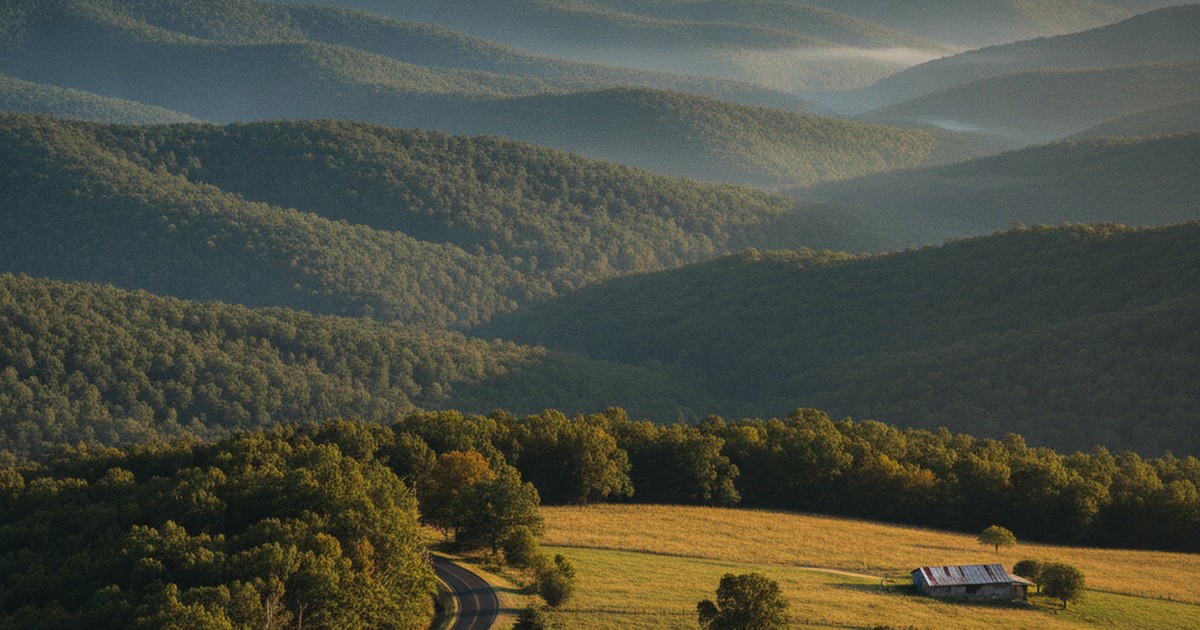
Living in rural Arkansas is a set of numbers, not a mood. From the four lots I own outside Horseshoe Bend, it is 26 minutes to a Walmart, 30 minutes to the nearest 24 hour emergency room, and the internet is fiber. You can work remotely from there. The isolation is real and it is specific.
Most buyers ask me about the price. Fewer ask what a Tuesday looks like.
What living in rural Arkansas costs you in drive time
Here is the honest table. These are measured from the four contiguous lots I own on the Strawberry Drive side of Horseshoe Bend, in Izard County.
| Where you are going | Distance | Drive time |
|---|---|---|
| Horseshoe Bend town center | about 3 mi | about 7 min |
| Crown Lake | 5.9 mi | 13 min |
| Walmart Supercenter, nearest one | 13.7 mi | 26 min |
| Fulton County Hospital, Salem, nearest 24 hour ER | 17.2 mi | 30 min |
| Mountain Home, the regional hub | 51.4 mi | 1 hr 6 min |
One caveat on that first row. The three mile figure is an estimate from the subdivision's location, not a route I measured door to door. Everything below it was measured.
A second caveat matters more. Those numbers belong to those four lots and nowhere else. A lot on the opposite side of the same small town runs a different set of distances, which is why I measure every parcel separately instead of copying a table across a listing page.
The density behind the numbers: Izard County held 13,577 people across 581 square miles of land at the 2020 census, about 23 people per square mile. Horseshoe Bend itself had 2,440 residents and is spread across three counties, which is unusual and tells you something about how the place was drawn.
What happens when you need a doctor?
There is a clinic in town. ARCare Horseshoe Bend Medical sits on 3rd Street and runs Monday to Friday, 8 to 5. It is primary care, not an emergency room.
For anything at two in the morning, the nearest hospital with an emergency room staffed by a physician in house around the clock is Fulton County Hospital in Salem, a 25 bed critical access hospital. From my lots that is 17.2 miles and about half an hour.
I have not found a published ambulance response time for that area, so I am not going to invent one. What I can tell you is that the same 17 miles has to be covered twice, out and back.
If you are retiring on the land, that half hour is the number to sit with. If you are buying to hold, or to camp on a few weekends a year, it is a footnote.
What wildlife will you actually run into?
Two animals come up in every thread I have read about moving to the Ozarks, and both are real.
Snakes. Arkansas has six venomous species, per the University of Arkansas extension service: the eastern copperhead, northern cottonmouth, western diamond backed rattlesnake, western pygmy rattlesnake, timber rattlesnake and the Texas coral snake. The same piece makes the practical point, which is that snakes go where the food and the shelter are. That is a housekeeping question more than a wilderness one.
Bears. The Arkansas Game and Fish Commission counts over 5,000 black bears in the state today and credits a restoration program that ran from 1958 to 1968, which it calls the most successful reintroduction of a large carnivore in history. The Encyclopedia of Arkansas fills in the mechanics: starting in 1959 the commission released 256 bears brought in from Minnesota and Canada, and the population came back across the Ozark Plateau and the Ouachita Mountains. Horseshoe Bend sits on the Ozark side of that map.
Now the part a seller usually skips. I do not know what walks across Lot 29 in a given week, and neither does anyone else, because nobody has surveyed a quarter acre for wildlife. Anyone who tells you a specific small lot is bear free is guessing at you. What is true is that this is bear country and snake country, statewide and by county, and you plan for it the way locals do.
What is the weather like, and what breaks?
The National Weather Service office in Little Rock puts the state's annual average at 37 tornadoes, and it splits the year in two rather than one. Of the 891 tornadoes recorded in Arkansas between 2000 and 2022, 339 of them, 38 percent, landed in the September to February half. The spring season everyone expects is only part of the picture.
Winter is the part people get wrong. Snow is not the problem. Ice is. Ozarks Electric, a cooperative over in the north west of the state, spells out the mechanism on its own outage page: ice clings and builds on lines and limbs until the trees come down and bring the wires with them, and it does more damage than snow for exactly that reason. It also explains the restoration order, which is main lines first because they bring the most people back fastest, then the tap lines, then individual services. If you are at the end of a rural service line, you are last in that sequence by design.
That is not an argument against the place. It is an argument for a generator, a wood stove and a full pantry.
Can you actually get internet out there?
This is the answer that surprises people, and it is the reason the word "isolated" undersells the reality.
The local electric cooperative, North Arkansas Electric, is headquartered in Salem, the same town as the hospital, and it did not wait for a carrier to show up. It built its own fiber network through a subsidiary called NEXT. As of November 2024 the co-op reported 3,615 miles of fiber deployed and more than 20,000 subscribers, with the first customers connected in late 2016. Public coverage data lists Horseshoe Bend as a NEXT service area with plans running up to 1 Gbps.
So the cliché of the cabin with one bar of signal is out of date here. You can work remotely from this county.
What I will not tell you is that fiber has been pulled down the specific street your lot sits on, because I have not confirmed that for any individual parcel, and town level coverage is an average, not a promise. Nor do I know the cell signal standing on the lot itself. Both are one phone call away with a parcel number in hand, and that call is worth making before you build a plan around it.
What I own out there, and where my knowledge stops
I own seven lots in Izard County, Arkansas. Four of them are contiguous, in the Spring Addition on the Strawberry Drive side of Horseshoe Bend, and they came out of a single package. The other three sit in different additions on the other sides of the same town.
The rules on those four are known and written down. Minimum build is 1,000 square feet, single family, site built. No mobile or manufactured homes. There is no city sewer at that location, so septic is on the buyer. Power and water run through the subdivision. I hold them on a Limited Warranty Deed and the buyer receives the same type, which is a distinction I would rather state plainly than round up.
Here is what I will not claim. I have not lived there. I have not spent a February there. Every number in this post came from a map, a county document or a published source, and I will hand over the source for any of them. What a winter feels like in a town of 2,440 people is not something a deed can tell you, and I am not going to write a paragraph pretending otherwise.
The entry terms are the same across the inventory: $149 at signing, then $105 a month for 48 months, at 0% interest. No credit check. That is the whole structure, and I went through the reasoning behind it in the post on what fair owner financing terms look like.
Where this fits in the rest of the homework
Lifestyle is the last question, not the first. Before you get to whether you would like it out there, the land itself has to survive the boring checks: legal access, build rules, utilities, taxes and a clean chain of title. That sequence is laid out in the rural land due diligence checklist.
Two of those checks connect directly to daily life here. Septic is the one that decides whether a lot can hold a house at all, and I covered how it works in Arkansas in the post on septic systems on rural land. And if you are reading this from a laptop several time zones away, the honest limits of what a screen can tell you are in the post on buying land sight unseen.
FAQ
How far is the nearest hospital in rural Izard County?
From the four lots I own on the Strawberry Drive side of Horseshoe Bend, Fulton County Hospital in Salem is 17.2 miles and about 30 minutes by road. It is a 25 bed critical access hospital with an emergency room staffed by a physician in house around the clock. There is a primary care clinic inside Horseshoe Bend itself, open weekdays only.
Are there bears and venomous snakes in the Arkansas Ozarks?
Yes to both. Arkansas has six venomous snake species according to the University of Arkansas extension service: the eastern copperhead, northern cottonmouth, western diamond backed rattlesnake, western pygmy rattlesnake, timber rattlesnake and Texas coral snake. The Arkansas Game and Fish Commission counts over 5,000 black bears in the state, and the Encyclopedia of Arkansas places that recovered population across the Ozark Plateau and the Ouachita Mountains. Horseshoe Bend is on the Ozark side.
Can you get high speed internet in rural Arkansas?
In this part of the state, often yes. North Arkansas Electric, the cooperative based in Salem, built its own fiber network through a subsidiary called NEXT. As of November 2024 the co-op reported 3,615 miles of fiber and more than 20,000 subscribers across its service area, and public coverage data lists Horseshoe Bend with plans up to 1 Gbps. Coverage at town level is not the same as coverage at your street, so confirm the address before you count on it.
How isolated is Horseshoe Bend, Arkansas?
Horseshoe Bend had 2,440 residents at the 2020 census and spreads across three counties. Izard County as a whole held 13,577 people over 581 square miles of land, about 23 people per square mile. There are services in town. There is no traffic, and there is no second option if the one grocery run does not have what you need.
What is the weather like in the Arkansas Ozarks?
The National Weather Service office in Little Rock puts the state's annual average at 37 tornadoes, and 38 percent of the 891 recorded between 2000 and 2022 fell between September and February, so it is not only a spring problem. Winter is less about snow and more about ice, which loads power lines and tree limbs until something comes down. Rural lines take longer to restore than town lines.
Rural Arkansas is not remote in the way the word sounds. It is a 26 minute grocery run, a 30 minute emergency room, a gigabit connection, and copperhead country. Whether that adds up to a good life depends entirely on which of those four items you read first.
Want to see the lot those distances were measured from? Here is Lot 29 in the Spring Addition, 0.27 acres, with the parcel number on the page so you can check any of this against the county yourself. Which of the numbers above would be the dealbreaker for you?
P.S. We wrote down the 12 questions worth asking any owner financing seller before you send money, with our own answer next to each one. It is free, it is three pages, and you can get it at the top of this page.
This is not financial or legal advice. Buying land involves risk. Do your own research before purchasing any property.