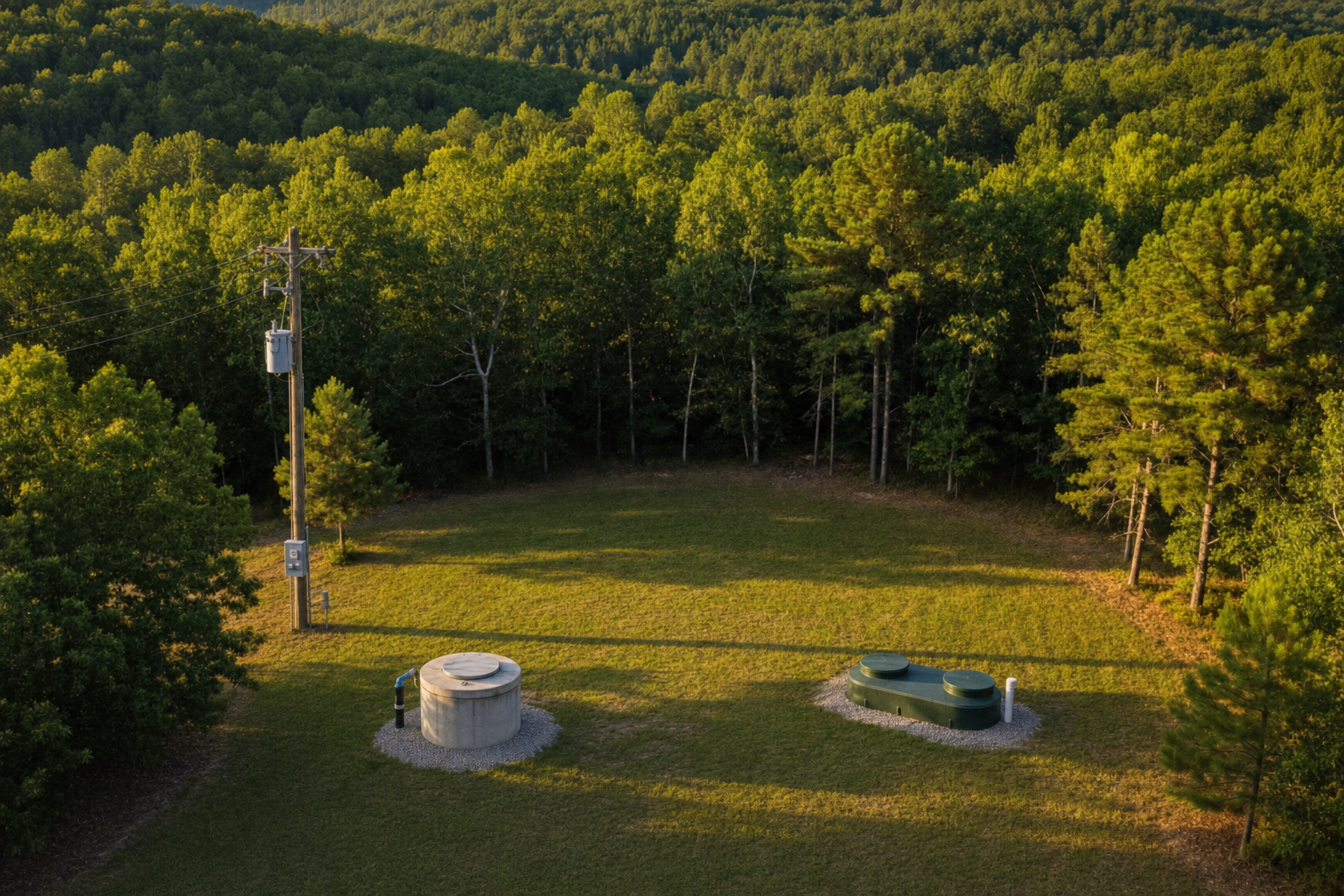
Cost to put utilities on raw land: well, septic, power
The cost to put utilities on raw land is usually the biggest number in the project, and it is bigger than the land. In Arkansas a drilled well runs about $25 to $55 a foot, a septic system needs a state permit and a soil evaluation before anyone digs, and power is priced per job by the local cooperative based on distance. None of the three has a sticker price.
That last sentence is the part that catches people. You can price a parcel to the dollar in ten seconds. You cannot price the well until someone drills it, because the number that decides the bill is how deep the water is, and nobody knows that until the bit goes down.
What is the real cost to put utilities on raw land?
Three separate systems, three separate vendors, three separate timelines. Here is how they break down in Arkansas.
| System | What sets the price | Published range |
|---|---|---|
| Water well | Depth to water, then pump and tank | $25 to $55 per foot drilled, about $6,105 for an average 165 foot well; $4,000 to $12,000 for a finished system |
| Septic | Soil evaluation result, bedroom count | Permit required first; price set by the installer after the site evaluation |
| Electric service | Distance from the nearest line | Quoted per job by the cooperative under a tariff filed with the state |
Those well figures come from published 2026 Arkansas cost data, which puts drilling at roughly $25 to $55 per foot and the average residential well at 165 feet. Add $1,000 to $3,000 for a pump and $300 to $800 for a pressure tank, and permits in the $25 to $100 range. A shallow well and a deep well on the same road can differ by thousands.
How much does a water well cost in Arkansas?
Drilling is sold by the foot, so the honest answer is a range with one unknown in the middle. At $25 to $55 a foot, a 165 foot well is somewhere between $4,100 and $9,100 before you own a single drop of water. The pump and the pressure tank are what turn a hole into a water system.
Two things worth knowing before you call a driller. First, ask what happens if the first hole comes up dry, because that is a real outcome and the contract should say who pays for the second attempt. Second, well depth in a given area is not a mystery to the people who work there. A local driller has drilled the neighbors. Ask what the wells around that parcel came in at.
Water supply and water rights are separate questions. What you are allowed to pump is covered in my post on water rights on rural land. This post is about what the physical system costs.
What does a septic system need in Arkansas?
A permit, before installation. The Arkansas Department of Health is clear about the sequence, and there is exactly one exemption: a single residence on ten or more acres where every part of the sewage system is more than 200 feet from any property line, roads included. Small rural lots do not clear that bar, so the permit applies.
The evaluation itself surprises people who came expecting a perc test. Arkansas uses soil pits instead. A Designated Representative digs a pit to read the depth to rock, any impervious layer, and how high groundwater rises in the wet part of the year, which a percolation test cannot show. The work can be done by a registered professional engineer, a registered professional land surveyor, a registered professional sanitarian, or a licensed master plumber.
Three design factors decide the system: soil suitability, the number of bedrooms in the house, and a 100 foot setback from any water well. And there is no minimum lot size in the state rules. That cuts both ways. A quarter acre lot with good soil can pass where five acres of shallow rock fails, which is why the soil evaluation is the first check worth paying for, not the last. The mechanics of the system itself are in my post on septic systems on rural land in Arkansas.
The order matters more than the price. If the soil says no, the well and the power do not matter.
How do you find out what power will cost?
You ask the cooperative that serves the parcel, and you ask early.
In Izard County the provider is North Arkansas Electric Cooperative, based in Salem. It is a member owned rural utility with more than 4,500 miles of distribution line and 25 substations serving roughly 33,000 accounts, which makes it the fifth largest co-op in the state. New service requests go through its engineering department, and its extension of facilities tariff is on file with the Arkansas Public Service Commission.
I did not obtain a published per foot rate for a line extension, and I am not going to invent one. The co-op prices each extension against the specific job, so the only number that means anything is the one they quote for your build site. Call the engineering department at 870-895-6213 with the parcel number and ask three things: how far is the nearest energized line from where I want to build, what does the member pay toward the extension, and what has to be in place before you will set a meter.
That third question is the one that reorders a schedule. Utilities usually want a driveway, a stake, and sometimes a permit before they will run anything.
What this looked like on my own Izard County lots
I own seven parcels in Izard County, and I will be straight about what I have and have not done on them: I have not drilled a well or installed a septic system on any of them. I buy and sell land. Claiming site experience I do not have would be worth less to you than the numbers I can actually verify.
What I can verify is the constraint each parcel carries, because that is what I had to read before buying. The Crown Lake parcel, Lot 192 in the North Shore Addition, is 0.35 acres with a minimum build of 1,100 square feet including the carport. The Tract D lot runs 0.25 acres with a 550 square foot minimum, and the Spring Addition parcels sit at 1,000. Three additions in the same town, three different minimums.
That matters here for one reason. The minimum build size sets the bedroom count you are realistically designing around, and the bedroom count is one of the three inputs the Health Department uses to size a septic field. The rules interlock. You are not pricing a well, a tank and a meter as separate line items. You are pricing a house, backward.
Which is why I tell buyers to run the full due diligence checklist before the money moves, not after.
FAQ
How much does it cost to drill a water well in Arkansas?
Published 2026 cost data for Arkansas puts drilling at roughly $25 to $55 per foot, with the average residential well at about 165 feet and around $6,105 for the drilling. A pump adds $1,000 to $3,000, a pressure tank $300 to $800, and a finished system commonly lands between $4,000 and $12,000. Depth is the variable nobody can quote in advance.
Do you need a permit for a septic system in Arkansas?
Yes. The Arkansas Department of Health requires a permit before installation. The single exemption is a residence on ten or more acres where every part of the system sits more than 200 feet from any property line, including roads. Most small rural lots do not qualify.
Is a perc test required in Arkansas?
Not in the classic form. Arkansas has Designated Representatives evaluate the site with soil pits rather than percolation tests, because a pit shows depth to rock, impervious layers, and wet season groundwater. A registered engineer, land surveyor, sanitarian, or licensed master plumber can perform it.
Is there a minimum lot size for a septic system in Arkansas?
No. The state says there is no minimum lot size. The soil evaluation, the bedroom count, and a 100 foot setback from any water well are what decide whether a system fits. Good soil on a small lot can pass where a big lot with shallow rock fails.
What order should I do these in?
Soil evaluation first, then power, then the well. The soil result can end the project outright, the power quote can reprice it, and the well is the number you cannot pin down until someone drills. Spending on the well before the soil comes back is spending against an unknown.
Before you buy
Price the land and the systems as one number. A cheap parcel with a failed soil evaluation and a half mile to the nearest power line is not cheap, and a slightly dearer lot near an energized line with clean soil can be the better buy on total cost.
If you want to see what an actual parcel and its build constraints look like written out, the Crown Lake lot page lists the addition, the acreage and the minimum build size on one screen.
This is not financial or legal advice. Permit rules, fees and utility tariffs change, and every parcel is its own case. Confirm the current requirements with the Arkansas Department of Health and the serving cooperative before you commit money.