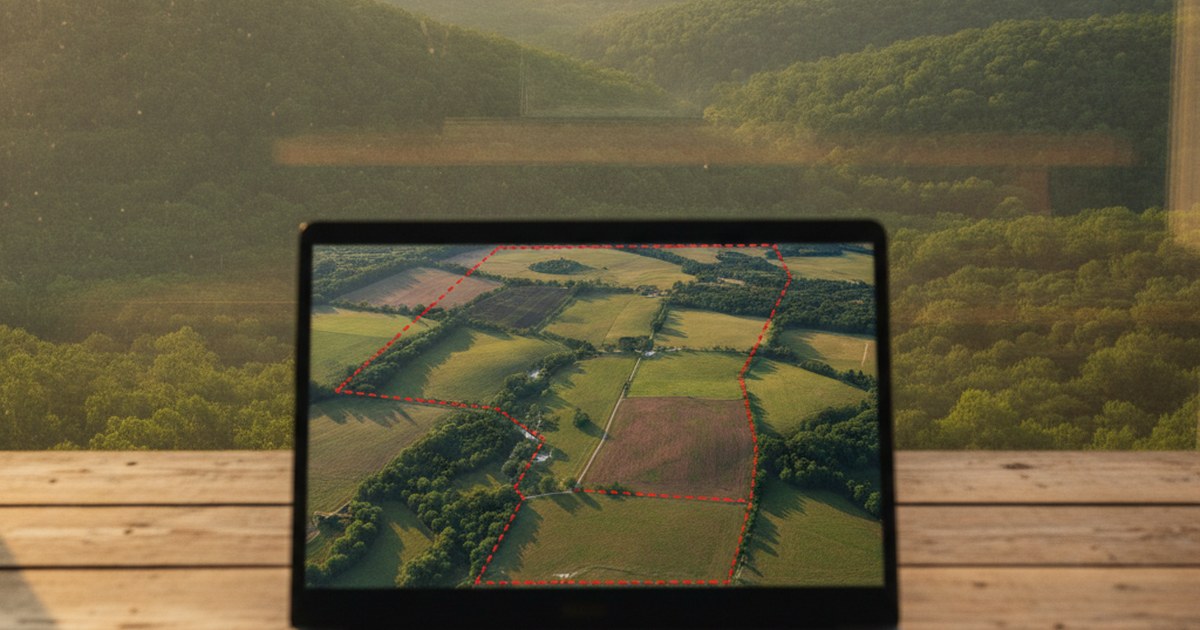
Buying land sight unseen is standard practice in the cheap rural market, and you can do it safely if you verify five things before you pay. It becomes reckless only when a buyer treats photos as proof. The photos are marketing. The county records are the evidence, and they are all online.
I should say plainly that I do this myself. Every parcel I own in Izard County, Arkansas was bought without me standing on it first.
Is buying land sight unseen actually crazy?
It is a cost question before it is a risk question.
Flying to north Arkansas, renting a car and staying two nights costs more than several of the lots I sell. On a $1,995 parcel, a trip can double the price of the purchase. Nobody does that, which is why the entire small acreage market runs remotely, and why sellers who insist you must see it in person before they will talk are often the ones with something to hide.
The real danger is not distance. It is buying from a listing rather than from a record. A listing can call a lot buildable when the subdivision requires a dwelling larger than the lot comfortably holds. A record cannot.
The five checks to run before you send money
Every one of these is free or nearly free, and every one can be done from a laptop.
- Owner of record. Search the county assessor for the parcel number and confirm the name on file matches the person or company selling it. A mismatch is not always fraud, but it always needs an explanation before you pay.
- Parcel number, not the address. Rural addresses drift and street names repeat. The parcel number is the identity of the land. Confirm the number on the payment page matches the number on the county record.
- Taxes current. Look up the tax bill for that parcel. Small back taxes are common and cheap to clear, but you want to know the number before it becomes yours. I broke that down in the post on property taxes on rural land in Arkansas.
- Legal access. A lot you cannot lawfully reach is worth a fraction of one you can, and satellite images hide this perfectly. A track on the aerial photo is not a right to drive on it. The details are in the post on legal access and landlocked land.
- What you may build. Subdivision rules set minimum dwelling size and setbacks, and they differ between additions inside the same town. Ask the seller for the exact addition name and read it yourself.
That list is the short version of the longer rural land due diligence checklist, which is worth reading in full if this is your first purchase.
What a photo will never tell you
Some things genuinely do not survive the trip through a camera, and an honest seller names them instead of hoping you forget.
| Answered from your laptop | Needs boots on the ground |
|---|---|
| Ownership, parcel ID, taxes | How steep the last 50 feet really are |
| Legal access and easements | Whether the soil drains after rain |
| Minimum build size, setbacks | Noise from the nearest road |
| Flood zone, rough elevation | What the neighbors have parked next door |
| Distance to town, utilities at the road | The smell and feel of the place |
The right column is not a reason to avoid a remote purchase. It is a reason to keep the purchase small enough that being wrong is survivable, and to time your first visit before the deal becomes irreversible.
How I bought my own land without visiting it
I live in Israel. The parcels are in north central Arkansas. Nothing about my situation allowed a casual drive out to look.
The first parcel I bought, a 0.35 acre lot in the North Shore addition of Horseshoe Bend, was signed and notarized on 15 April 2026 and recorded with the Izard County Clerk on 28 April 2026, Book 2026 Page 6725. I checked the ownership record, the addition's build rules and the tax bill before I paid, and I have the recorded deed to show for it.
The second purchase was four contiguous lots from a seller in Virginia, notarized electronically in May 2026. Same process, no flights, no title company drama, and a deed recorded in the county where the land sits.
What I did not do is pretend the terrain is something I verified with my own feet. When a buyer asks me about slope or drainage on a specific lot, the honest answer is that those are questions for a visit or for someone local, and I say that rather than inventing a description.
What protects a remote buyer after the money moves
Read the refund and cancellation terms before you pay, not after. This is the single sentence most sight unseen buyers skip.
On my owner financed lots the document fee is not refundable, but the down payment is refundable for 90 days. That window exists precisely for this problem: it gives a remote buyer a full season to drive out, walk the lot, and back out if the place is not what the photos suggested. On a cash purchase the structure is different, with a cancellation window that runs until the deed is recorded.
Ask any seller two direct questions. What is your refund window, and what exactly is non refundable? A seller who answers both in writing before payment is a seller you can buy from remotely. A seller who gets vague is telling you something useful.
FAQ
Is buying land sight unseen a bad idea?
It is normal in the cheap rural market and risky only if you skip verification. On a lot under $3,000 a flight and two hotel nights can cost more than the land, so the sensible move is to spend that budget on checking records, access and terrain instead of on travel.
What should I check before buying land online?
Five things: that the seller is the owner of record at the county, that the parcel number matches the one you are paying for, that the taxes are current, that there is legal access to the lot, and what the subdivision rules allow you to build. All five can be checked from a laptop.
Can I get my money back if the land is not what the photos showed?
That depends entirely on the seller, so read the refund terms before you pay rather than after. On my owner financed lots the down payment is refundable for 90 days, which is long enough for a buyer to drive out and stand on the property before the decision becomes final.
How do people close on land remotely?
By electronic signature and a remote notary, then the deed is recorded at the county. I bought my own parcels this way. The four contiguous lots I hold in Horseshoe Bend came from a seller in Virginia and were notarized electronically in May 2026.
Buying land sight unseen is not a leap of faith when the five checks come back clean and the refund window is written down. It becomes a leap of faith the moment you skip one of them because the price felt too small to bother.
Want to run the checks on something real? Here is the 0.25 acre lot on Pavilion Lane in Horseshoe Bend, with the parcel number and the addition listed so you can verify it against the county yourself before you talk to me. Which of the five checks feels hardest from where you sit? Ask me and I will point you at the exact page.
P.S. We wrote down the 12 questions worth asking any owner financing seller before you send money, with our own answer next to each one. It is free, it is three pages, and you can get it at the top of this page.
This is not financial or legal advice. Buying land involves risk. Do your own research before purchasing any property.