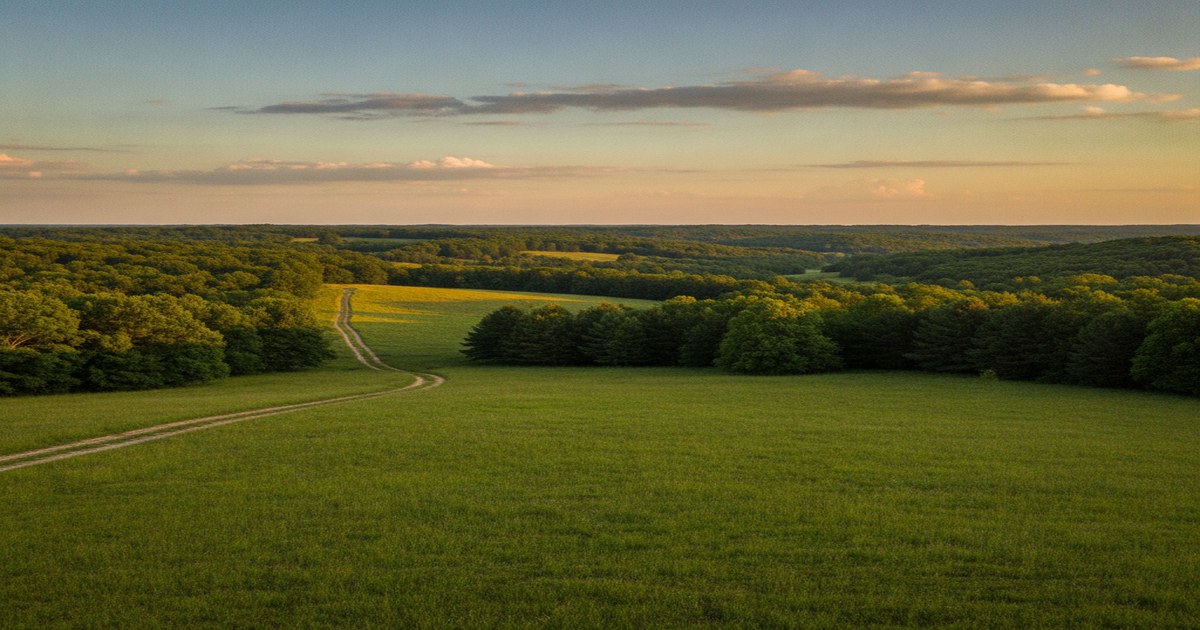
It is the evening after a bank said no, and you are searching whether land is still on the table. It is. You can buy owner financed land for bad credit, because the seller becomes your lender and skips the credit check. On the lots I sell in Izard County, Arkansas, nobody pulls a credit report: $149 at signing, then $105 a month for 48 months.
There is no FICO minimum, no underwriting, and no bank officer deciding your fate. Below is who qualifies, what a seller actually looks at instead of a score, and the real 2026 numbers.
Can you get owner financed land for bad credit?
Yes. And it is not a loophole. It is just how owner financing works.
When a bank lends on land, it sorts people by a number. Score too low, application denied. The bank never meets you. A computer reads your file and says no.
Owner financing flips that. The person selling the land is the lender. They are not bound by bank rules, so they set their own. Most sellers who finance rural land care about one simple thing: can you make the monthly payment. That is a practical question, not a credit question. (If you want the full mechanics first, start with how owner financing on land works.)
A low score, a past bankruptcy, a thin file from never borrowing. None of it ends the conversation. In owner financing, a buyer who is up front that their credit is wrecked is in the same position as anyone else.
How common is it to get turned down for credit?
More common than it feels that evening. In the Federal Reserve's survey of household finances in 2025, published May 2026, 33 percent of adults applied for some type of credit, and one third of those applicants were either denied or approved for less than they asked for.
So a no from a bank puts you in a very large group. It says the application did not fit a lender's scoring rules. It does not say you cannot pay a fixed amount every month.
That gap, between "does not fit the model" and "cannot pay", is exactly where owner financing lives.
How many people have no credit score at all?
About one adult in eight. The Consumer Financial Protection Bureau's June 2025 update estimates that 87.5 percent of U.S. adults had a scored credit record in December 2020. The remaining 12.5 percent either had a record too thin or too stale to score, or no credit record at all. That last group alone was 2.7 percent of adults, about 7.0 million people.
Many of those people pay every bill on time. They simply never borrowed in a way the credit bureaus track. To a bank, no score often reads the same as a bad score.
If you are sitting on a decent score and wondering how much it matters, I wrote a separate piece on what credit score you need for owner financed land. Short version: on my lots, none.
What does the seller check instead of a credit score?
Three things: the down payment, steady income, and basic ID. A credit score is a shortcut a bank uses because it does not know you. A seller who finances the land directly does not need that shortcut.
| What a bank checks | What an owner financing seller checks |
|---|---|
| Credit score (FICO) | Down payment |
| Debt-to-income ratio | Steady income from any source |
| Employment history | Basic ID |
| Underwriting and appraisal | Nothing else |
The down payment is the real signal. It shows you have skin in the game. The income tells the seller you can cover the monthly payment month after month. The ID keeps the paperwork clean and legal. That is the whole list.
Notice what is missing. No two years of pay stubs. No tax returns. No letter explaining a late payment from 2019.
Who actually qualifies for owner financed land with bad credit?
More people than you would think. Owner financing tends to fit buyers who get filtered out by banks for reasons that have nothing to do with whether they pay their bills.
A few examples of who buys land this way:
- Someone rebuilding after a bankruptcy or a rough stretch
- A young buyer with almost no credit history yet
- A new arrival to the country with a thin file
- A self-employed person whose income is real but messy on paper
- Someone who pays cash for everything and never built a score
If you have a down payment and steady income from any source, you are likely a fit. Income from any source matters here. A job, a side business, benefits, a pension. The seller cares that the money comes in, not where it comes from.
How does an owner financed land deal work, step by step?
Four steps, and none of them involve a bank. The process is short on purpose, because the whole point is to skip the bank.
First, you pick a parcel. Second, you pay a small down payment and a one-time document fee online. That locks the land in your name. Nobody else can buy it while you are paying.
Third, you sign a purchase contract. It spells out the price, the monthly payment, the term, and what happens if you fall behind. Read it. A real contract protects you as much as the seller, and if you want to know the worst case before you sign, here is what actually happens if you miss a payment.
Fourth, you make a fixed monthly payment until the balance is gone. When the last payment clears, you get a warranty deed or limited warranty deed, whichever YAI holds for that parcel (stated on each lot page), and the land is legally yours.
No appraisal. No title company waiting room. No 45 day close.
How much does owner financed land cost if your credit is bad?
Exactly the same as if your credit is perfect. The score is not part of the price either. Here are the 2026 terms on my Izard County lots:
| Cost | Owner financing | Cash |
|---|---|---|
| Due at signing | $149 ($49 down plus $100 document fee) | $1,995 to $2,499, depending on the lot |
| Monthly | $105 for 48 months ($95 toward the price plus $10 servicing) | None |
| Card processing | 1.9% on each payment | 1.9% if paid by card |
| Credit check | None | None |
That is the shape of it: you get in for $149 instead of about $2,000 at once. Every lot page shows its own cash price and financed total, so you are never guessing. For a line by line breakdown, see how much money it takes to buy rural land.
Yes, you pay more over the full 48 months than a cash buyer pays today. That extra is the price of not needing a bank, and of the seller waiting four years for their money. For a buyer who cannot get approved anywhere else, that trade is often worth it.
Why does this model work for buyers banks reject?
Because it judges the payment, not the past. A lot of buyers who come to owner financing lead with an apology about their credit. They do not need to. In a no-credit-check structure, the score is simply not part of the decision.
The people drawn to owner financing are rarely trying to game anyone. They tend to be people with steady income and a real reason to want land, who got told no by a bank over a number on a screen. Give them a fair contract and a payment they can handle, and the arrangement works the way it is designed to: a fixed payment, on time, every month, with the deed held as security until the balance is clear.
That is the part the credit score never captured.
FAQ
Can I buy land with bad credit?
Yes. With owner financing the seller acts as the lender, and most sellers do not pull a credit report. They care whether you can make the monthly payment, not what your score is. A small down payment is usually all you need to show you are serious.
Does owner financing check your credit?
Most owner financing on rural land does not check credit. The seller is not a bank, so there is no FICO minimum and no underwriting department. Instead the seller looks at the down payment, a steady source of income, and basic ID. The land itself is the security, because the deed stays with the seller until you pay it off.
What do sellers check instead of a credit score?
Sellers usually check three things: the down payment, whether you have steady income from any source, and your identity. The down payment shows commitment. The income shows you can cover the monthly payment. The ID keeps the contract clean. A bankruptcy, a low score, or no credit history does not block you.
Can I buy land with no credit history at all?
Yes. No credit history is treated the same as bad credit in owner financing, which is to say it is usually a non-issue. New arrivals, young buyers, and people who pay cash for everything all run into a thin credit file. A seller who finances the land directly does not need that file to say yes.
Is owner financed land with bad credit more expensive?
You pay more over time than you would with cash, because the seller carries the risk of lending to you and waits years to be paid. That is the trade. For a buyer who cannot get a bank loan, the comparison is not owner financing against a cheaper bank loan. It is owner financing against not owning land at all.
If your credit has been the thing standing between you and a piece of land, this is the path that ignores it. Leave your email below and I will send you the parcels we have open right now, with the real down payment and monthly numbers for each. No credit check, no pressure. And if a bank turned you down this year, what was the reason they gave?
Prefer to see the lots without leaving an email? Every parcel we sell now has a public page with the APN, a map link, real aerial photos, the current tax bill, and the build minimum: browse the available lots, or jump straight to the 0.35-acre lot near Crown Lake.
This is not financial or legal advice. Buying land involves risk. Do your own research before purchasing any property.
Sources
- Federal Reserve: Report on the Economic Well-Being of U.S. Households in 2025 (May 2026), Credit
- Consumer Financial Protection Bureau: Technical correction and update to the CFPB's credit invisibles estimate (June 2025)
- Current YAI LLC purchase terms as published on each parcel page (2026)
- No Credit Check Land Financing Guide (Dollar Land Store)
- Land Contract (Wikipedia)
- Land Loans Explained (Quicken Loans)
- How to Finance Land (Mossy Oak Properties)